Monday, 11 May 2020

Working from home - turning problems into solutions

In the core store at BGS, we are heavily reliant on our team of three technicians. They take our incoming material in the form of core, cuttings or other samples, and enter it onto our database, and then store the material in our core store where it can be accessed by visiting researchers. If you've ever visited the BGS core store, then the material you looked at will have been laid out on the examination benches by one of them.

The sudden onset of lockdown at the end of March meant that progress on all of these activities ceased, practically overnight. Fortunately, we had a long list of "back-burner" activities that we were able to bring up. Many of our staff were also generous enough to volunteer the loan of their own IT equipment amidst a global laptop shortage.

Here, Neil Stacey, one of our Curating Technicians, shares his home working setup:


"In the photo, you can see:

  • Personal Apple Mac version 10.6 using 17” screen for Excel .xls data input
  • Personal 9” iPad for viewing and downloading marine images
  • Personal clock to see how much time spent on data input
  • Personal ruler for measuring how long I have been inputting data(!)
  • Personal phone to order takeaways...

We loaded a number of photographs of pallets of our Marine samples onto ShareFile (our corporate filesharing platform), which I was then able to download to my iPad. Working from home I have been able to extract handwritten data on the ends of the boxes into an Excel spreadsheet. This has included:


There can be a lot of data trapped in handwritten annotations

  • 26,000 marine sample locations, almost all matched to existing barcode data
  • 5,000 miscellaneous borehole entries
  • 497 Hydrographic Office samples
  • 146 Entries relating to the Falkland Isles
  • 2,180 Shallow commercial UK continental shelf samples

So in a few short weeks of lockdown, I have been able to enhance the data we hold on about thirty  three thousand items in our collection."

As life begins to return to normal, we will import this into our corporate database, where it will be extremely useful and will really improve the day to day operation of our marine samples collection.

Thank you, Neil!

Friday, 1 May 2020

3D scanning our collections

Today, more than ever before, it is vital that we find new ways of sharing our collections in the virtual world, as well as the physical one. This post is the first in a series of posts showing ways in which you can access the BGS collections from the comfort of your own home or office.

The collections team has recently taken delivery of a new tool to help us in the digitisation of our collection. An Artec Space Spider joins our existing NextEngine laser scanners which we use to create 3D models of objects. Compared to the older hardware, our new scanner expands our capabilities greatly:
  • It's portable. Combined with a laptop this allows us to head into the stores and scan some of our larger items without having to move them far from their cabinets.
Scanning a large ammonite in the BGS core store
  • It's quicker. Scans of typical "hand specimen" sized objects now take around 15 minutes rather than the hour or more that it previously took.
  • Better detail. Typical scanning resolution is between 0.1 and 0.3mm which means that even fine details are visible in fossils. And we can apply a colour layer to the scan surface to accurately reflect the appearance of the original object.

Processing the scanned data

So how does this look in practice? Tom, a geology student at the University of Leicester, volunteered with us for several months, in between his studies. In that time, he undertook to scan representative examples of zonal ammonites in our collection.

These species are very important because they allow correlation of the relative ages of rock layers between different locations, so wherever in the world you find a given zonal species, you can be sure that you are looking at rocks of the same age. For example, geologists in the field would look for the first occurrence of the ammonite Psiloceras planorbis to mark the very start of the Jurassic period, although the situation is actually a little more complicated…

Tom scanned the ammonites using both our NextEngine and Spider scanners, with colour texturing turned off so that differences in the preservation of the specimens would not affect the perception of form of the fossils. He then uploaded them to Sketchfab, where they can be viewed in a web browser.

Comparing Lower Jurassic Zonal Ammonites
So the next time you're in the field, and can't remember your obtusum from your oxynoticeras, then load up our virtual collection at https://sketchfab.com/3dFossils/collections/jurassic-zonal-ammonites to make sure.

GSM 24881 Pleuroceras Ammonite 500K

Simon Harris
Collections Conservation and Digitisation Manager

Monday, 10 February 2020

Francis Redfern Blog

Francis Redfern, Cooper, Historian, Antiquarian, Artist, Poet, Diarist and Geologist 

Francis Redfern

The 19th century was a time when many an aspiring gentleman sought to improve his status in life through the pursuing of worthwhile hobbies and pastimes. One prime example of this was Francis Redfern.  Born in Fenny Bentley, near Ashbourne, in Derbyshire in 1823 he was the oldest of 10 children.  His father was the landlord of the Bluebell Inn. Francis received limited formal schooling in nearby Tissington, his school master John Smith, leaving a lasting impression on his life.  At the age of 15 he was apprenticed to a Cooper, Samuel Brassington, in Uttoxeter in Staffordshire.  At the time Uttoxeter was an important, but waning market town that the Industrial Revolution had passed by.  After completing his apprenticeship Francis purchased his own coopering business in Carter Street, supplying barrels for the transportation of both wet and dry goods.

In his spare time Francis indulged his interests and curiosities trying to record the history Uttoxeter.  Despite the town having a rich history stretching back to the early medieval period it had never been formally recorded.  Francis set out to change this: his work, The History and Antiquities of Uttoxeter and Neighbourhood, first published in 1857, encompassed the history of the town from ancient times to the present day.  During his investigations Francis studied the geology of the area around Uttoxeter to determine its origins and what was there before recorded human settlement, concluding that, “Uttoxeter is situated upon what is geologically termed the drift formation, which belongs to the upper tertiary epoch and immediately beneath the materials of the alluvium.”

Whilst conducting his research Francis was able to carry out fieldwork on geological formations that had been unearthed during work on the outer edge of the town to try to determine their origins.  Francis had access to only basic tools to help him determine details about the formations he was examining, often relying on chance discoveries made by others.


Today Francis’ home has been turned into a museum that continues to tell the story of Uttoxeter and its residents.  The exhibition display on Francis Redfern features geologist’s tools including a geologist’s hammer, a clinometer and a geological compass, all tools that would have been familiar to Francis during his time recording local geological formations.  These tools along with fossil samples have been kindly loaned by The British Geological Survey.


Guest blog by Gordon Collins, Curator - Uttoxeter Heritage Trust.

The National Geological Repository, BGS, is happy to loan specimens for secure public display in museums, galleries and similar facilities.

Solving stratigraphic problems

Andrew Taylor, Skolithos Limited

I am a consultant geologist working on stratigraphic problems, and so spend time looking at and sampling core and cuttings stored in the BGS in Nottingham. 

This is an excellent facility where material can be recovered from storage and laid out very efficiently.  I’ve recently started to use the BGS online database, which once you understand the pathways is a great resource. 

Go to www.bgs.ac.uk/services/ngdc which is the National Geological Data Centre and follow the links to deposited data and use the advanced search to type in a well you are interested in.  The available reports are listed and can be downloaded or requested. This saves both time and money as it enables a quick review of the existing public domain data (in my case biostratigraphic reports) so that duplicating the analysis and unnecessarily sampling of precious rock, can be avoided. Instead I can either spend the budget on sections not previously studied or hand the money back to the client.  Everybody wins.

Guest Blog by Andrew Taylor, Skolithos Limited


Wednesday, 15 August 2018

Building our new NGR Core Scanning Facility … by Dr Magret Damaschke


RXCT training course at the NGR Core Scanning Facility
Building our new NGR Core Scanning Facility … by Dr Magret Damaschke

My role at the British Geological Survey (BGS) is to deliver and supervise our new Core Scanning Facility at the National Geological Repository (NGR) in Keyworth.


It has been exciting start, as we prepare to open this facility for business in summer 2018.


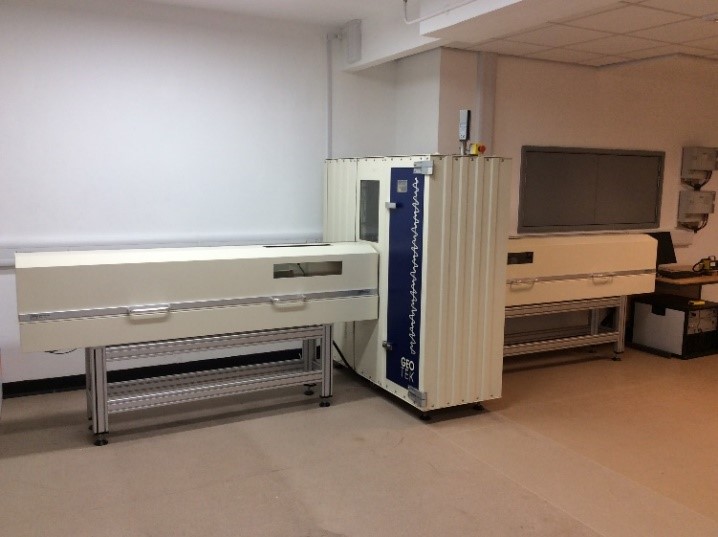
Funded by the Natural Environmental Research Council (NERC), the UK Geoenergy Observatories (UKGEOS) aim to facilitate world-leading research into UK’s sub-surface environment (read the science plan). UKGEOS allocated £1.4 million to create this new, state-of the art core scanning facility equipped with four high-resolution and automated core scanner systems for core imaging and non-destructive core analysis.


With these new capabilities whole, split, or slabbed rock and sediment cores can be continuously scanned to provide initial information on the geophysical, mineralogical, and geochemical characteristics of the core, record core quality and fundamental variations downcore, and allow high-definition optical, near-infrared (NIR), ultraviolet (UV), and X-radiographic images to be taken. These techniques minimise the need for destructive sampling and will enable scientist to target specific areas of interest for effective sub-sampling procedures.


Instrumentation


BGS takes great pride in purchasing from two market-leading analytical equipment suppliers: Geotek Ltd. and Cox Analytical Systems; both renowned for their cutting edge technologies that greatly contribute to scientific- and industrial-based applications.


Instruments that have been purchased for the NGR Core Scanning Facility include:


• Geotek Multi-Sensor Core Logger (MSCL-S)
• Geotek Rotating X-Ray CT Scanner (MSCL-RXCT)
• Geotek XRF Core Workstation (MSCL-XYZ)
• COX  XRF Tray Scanner (newly designed instrument)


Geotek Ltd. delivered the first two core scanners (MSCL-S and -RXCT) to the newly refurbished core scanning facility on 26th March 2018. Heavy instrument parts, weighting up to 1.3- ton, were carefully manoeuvred through the narrow corridors and installed by the experienced team. Afterwards, BGS staff members were trained to understand all the components and system parts, and on how to use the software to acquire, process and manage data.


MSCL-S and RXCT delivery and installation by Geotek Ltd.
Geotek Rotating X-ray CT Scanner (MSCL-RXCT)


The RXCT Scanner
We will be using the MSCL-RXCT to visualise and record internal structures present within the core to determine core quality, heterogeneity, and fracture network. The rotating source-detector assembly allows linear and rotational scans to be realised, which makes it a valuable tool to users who wish to extend from general 2D X-Ray radiographic core imaging to 3D X-Ray CT reconstructions. A digital rock software package (PerGeos) will help users to visualize, process, and rapidly interpret the digital core imagery.

Geotek Multi-Sensor Core Logger (MSCL-S)
The MSCL-S


Typical MSCL-S data set display
The MSCL-S will be used for ultra-high definition core images and geophysical analyses, including gamma density, magnetic susceptibility, non-contact electrical resistivity, P-wave velocity, colour spectrophotometry (including NIR), and natural gamma activity. This data will give scientist the opportunity to:
• Generate bulk density, porosity, salinity, and/or P-wave velocity profiles
• Map core quality, heterogeneity, and lithology variations downcore (e.g., grain-size, texture, colour)
• Estimate water-content and permeability
• Identify compositional changes (biogenic vs. terrigenous)
• Recognise fundamental features (e.g., gassy soils, cemented horizons, erosion surfaces, clay-rich layers, radioactive material, turbidites, tephra, detritus, etc.)
• Implement core-to-core and/or core-to-log correlations, and lateral correlation between core locations
• Provide information on the stratigraphic framework when logging has failed during exploration
• Catalogue and archive

Looking ahead, the delivery and installation of the COX Tray Scanner will be expected to take place at the beginning of May, shortly followed by the arrangement of the Geotek MSCL-XYZ.

The new opportunity


Once up and running, the NGR Core Scanning Facility will give scientists, academics and commercial companies the opportunity to facilitate outstanding scientific projects and add significantly to the general drill core data acquisition and exploration procedures. Compared with traditional analytical methods, these approaches greatly reduces the time, cost, and destructive nature of sampling.

Why slab it, when you can scan it!

Special thanks goes to the BGS Facility Management Team who completed reconstruction and enhancement of the existing facility, as well as the BGS Systems and Network Support Team who managed network connection, data storage and any other organisation needs.
For more information please contact me under magmas@bgs.ac.uk

Thursday, 5 July 2018

AAPG 2018 Convention, Salt Lake City

Following the great success of the BGS booth at the AAPG 2017 annual convention and exhibition in Houston, BGS attended the AAPG 2018 Convention, this time in Salt Lake City (https://ace.aapg.org/2018).
 
The BGS team included:

  • Jan Hennissen giving a talk 'Comparing the potential Bowland Shale play (Pennine Basin, UK) to the established Barnett Shale play (Fort Worth Basin, USA): A geochemical and palynological analysis of Mississippian (Carboniferous) mudstones'; 
  • Oliver Wakefield presented a poster entitled 'Lithofacies control on deformation band frequency and geometry: example from the Sherwood Sandstone Group, UK';
  • Tracey Gallagher provided information on BGS, in particular the core store, and the forthcoming NGR Core Scanning Facility.


The AAPG is attended by leading oil and gas companies, various national government departments concerned with mining and energy, many geological modelling organisations, and a number of universities from across the world.
 
BGS had a variety of visitors to the booth, including:

  • Zoe Shipton (Chair of the Science Advisory Group for the UKGEOS project), who was pleased to see the BGS represented and promoting the Core Scanning facility

  • Paul Wright  (PW Carbonate Geoscience & Nautilus (GTA)) enquired about holding more core store workshops

  • Nesha Nurse from the Barbados Ministry of Energy and Mining inviting BGS to attend a convention in Barbados …

  • We had enquiries about lithium data and hierarchical geological age codes for GIS applications – amongst other topics - and we also had visitors from last year's AAPG dropping by to say hello.   

Oliver and Jan also attended a number of talks and poster presentations. The technical presentations focused mostly on unconventional resources in the USA, with some dedicated sessions to unconventional resources globally. The UK was well represented with presentations from Jack Walker and Tom Fender (both BUFI and Newcastle University PhD students) focusing on the Bowland Shale, as well as Jan Hennissen (BGS).
 
Next year's AAPG Convention will be held in San Antonio, Texas; here's hoping the BGS will be represented again.


Tracey Gallagher, Oliver Wakefield & Jan Hennissen


Thursday, 7 September 2017

York (PG Dip) BGS Visit to York 24th July 2017

On the 24th of July, an eager and enthusiastic group of students on the University of York’s postgraduate diploma in ‘The Geology of Yorkshire and Northern England’ visited the National Geological Repository (NGR), at the British Geological Survey headquarters in Keyworth, Nottingham with their tutor Dr Annette McGrath. During the postgraduate diploma (PG Dip) programme, and as part of their second year residential week course, students visit the NGR for a full-day workshop every October, in order to examine key rock cores from several sub-surface boreholes of northern England. During the last workshop in 2016, Simon Harris, a professional Conservator at the BGS, kindly offered the students and myself the opportunity to revisit the BGS for a full tour plus the chance to view the fabulous resources at the NGR – and as you can imagine, we all jumped at the prospect! 
 
But as you read this blog, you may be wondering ‘what exactly is the PG Dip in ‘The Geology of Yorkshire and northern England?’ and why did students on this programme want to visit the BGS? The PG Dip is an exciting and unique part-time course, which was launched by The University of York in 2015, and it is conducted entirely online via distance learning over the period of two years. The programme introduces students to the spectacular regional geology of Yorkshire and northern England and its exceptional diversity of landscapes and classic geological sites. Through their examination and understanding of the region, students explore the main principles of geology and acquire the knowledge and tools required with which to interpret larger-scale Earth processes and structures. Students also assess the role of the area’s importance with respect to current controversies in the Earth sciences, whilst also reflecting upon the region's vital role in the history of Geology.

Figure 1: The Lower and Middle Jurassic
sequence near Saltwick Bay, Whitby,
as visited during the first year residential week course

The programme is aimed at anyone with an interest in geology and appeals to a wide range of geological audiences. Students engage with the course for a number of reasons, be they vocational or in order to gain a strong foundation for additional geological study or progression on to Masters or PhD level. However others engage purely out of personal interest, just for the sheer fun of it, as the programme offers students the opportunity to delve into, research and learn more about areas of their own holistic, personal geological interest. Whatever their reason for taking the course, on completion graduates are well-placed to pursue geological careers within academia or industry, if they so desire, or to utilise their knowledge to appreciate and interpret the rocks over which they walk. The programme begins every September with a residential week course at the University of York, during which time students take part in fieldtrips to classic, and in some cases world-famous geological sites in Yorkshire and then conduct lab-work on campus. An additional residential week course also takes place in October of the second year, as mentioned above, when students are provided with the opportunity to visit yet more fascinating geological sites in Yorkshire, as well as the core workshop at the BGS, as mentioned above. Which neatly leads me back to our visit to the BGS this July….


Figure 2: Enjoying the BGS immersive 3D visualisation facility.
We all arrived at the BGS during the morning of the 24th of July in order to spend some time drooling over and browsing the fantastic resources in the large onsite shop, where a vast selection of geological specimens, books, equipment and maps are on sale. Simon Harris then met us in reception, after we had had our fill of the shop, and he very kindly provided us with a fascinating and comprehensive tour of the BGS and its facilities. The tour began with an introduction to, and demonstration of the superb BGS immersive 3D visualisation facility.


After donning our glasses, we were treated to an interactive 3D flyover of the bedrock geology of northern England, which helped us to easily visualise how geology influences and controls the topography of the region. Simon then provided us with a very interesting and thorough presentation relating to the services that are available to academics and bona-fide researchers for free by the National Geoscience Data Centre (NGDC). This also included an onscreen demonstration from Simon of how the students could access the NGDC records online, which constitutes an enormous amount of crucial information and resources. From the fossil collections of Palaeosaurus and the GB3D Type Fossils database, to onshore borehole scans, the Geology of Britain Viewer, the NERC Open Research Archive and the iGeology App (to name just a few!), the NGDC offers a wealth of indispensable online information that underpins and is truly invaluable to an online distance learning programme like the PG Dip at The University of York. 


But that wasn’t all. We then visited the well-stocked BGS reference library en route to the NGR, which holds a vast collection of contemporary geological texts, maps, journals, technical reports and archival material, plus a range of fascinating historical tomes and seminal texts. Simon then kindly escorted us to the NGR itself, where we examined a wonderful variety of carefully selected geological specimens that he had located and displayed for us from northern England. Students were encouraged to search the online database in advance of the visit, so they could request to view specific specimens of particular interest on the day. Needless to say, we didn’t need much encouragement and grasped this fantastic offer with both hands, sending poor Simon a list as long as his arm! This provided both the students and myself with the rare opportunity to view and handle type fossils and key rock and mineral specimens from northern England, which was an invaluable occasion for students taking part in an online distance-learning course. We voraciously examined the samples on display, which included beautiful mineral specimens from the Pennine Orefield, an enigmatic trace fossil within ash deposits of the Borrowdale Volcanic Group, and a selection of elusive trilobite and graptoloid specimens from the Skiddaw Group of the northern Lake District – to name but a few.


Figure 3: PG Dip students in the NGR core store.
We then moved on to see the immense NGR core stores, where borehole cores, cuttings and samples from both the UK landmass and offshore continental shelf are in storage. Whilst there, we were treated to a demonstration of the amazing electronic sliding racks by Scott Renshaw, a truly fascinating and innovative way to move huge amounts of core material around! Next came a tour of the NGR records collection itself, where we admired the vast palaeontological collection, all carefully and accurately catalogued and usefully stored according to geological time period, plus a wealth of thin sections. Simon also impressed us with his ability to locate specimens when he accurately and deftly tracked down a sample of Cornish ‘luxullianite’, a beautiful and rare type of granite, for one especially interested student that had just returned from a trip to Cornwall.


Figure 4: A beautiful specimen of ‘luxullianite’ a rare Cornish granite.
At the end of a most informative day, the students enjoyed investigating the onsite BGS ‘Geological Walk’ where they cemented their knowledge of the regional geology of Britain further, by walking through three billion years of geological time, from the Precambrian rocks of the Scottish Highlands to more recent Quaternary glacial deposits. I think I can safely speak for everyone on the course when I say that a fantastic day was had by all, that everyone appreciated this fascinating and unique opportunity to view world-class resources in the flesh, and I for one can’t wait to return to the BGS again soon, for the second year residential week core workshop this October!


If you are interested to know more about the PG Dip in ‘The Geology of Yorkshire and northern England’ at the University of York, please visit the website: https://www.york.ac.uk/lifelonglearning/geology/ or email lifelonglearning@york.ac.uk or call 01904 328482 for further details.
Blog by Annette McGrath